The Smartest Person in the Room Still Can't Be in Every Room
Jul 1, 2026
5 mins read

Every company is in the middle of the same rollout. Give everyone an AI assistant. Put a copilot in the inbox, an agent in the code editor, a chat assistant one tab away. And it works - people draft faster, code faster, summarize faster. Individual productivity is up. But when you step back and look at the overall organization, the company isn't actually smarter. Each person got a faster version of themselves. The hard part of working in a large enterprise didn't move at all.
In enterprises, the bottleneck was never how fast any one person can operate. It's that the information you need lives in someone else's head, someone else's thread, someone else's drive - and you don't know who, or you do know who and they're in back-to-backs until Thursday.
Knowledge workers spend close to a fifth of every week just searching for information or tracking down the colleague who has it. The most common complaint isn't "I can't find the document" - it's "I can't find the right person." And the cost of all that un-shared knowledge runs into the tens of billions a year for large enterprises, not because the knowledge doesn't exist, but because it can't travel.
A personal AI assistant makes you faster at your work. It does nothing for the part where your work depends on everyone else's. If anything, when every individual is moving faster in their own silo, the gaps between silos get more expensive, not less. That gap - the collaboration tax - is the actual problem worth solving. And solving it requires a different kind of assistant.
An assistant you can share, anywhere
A Digital Twin is built to collaborate with your teammates. It's an AI version of a person's expertise - how they think, what they've decided, how they communicate, the context behind their work - that other people can ask, use, and bring into their own day. It's an assistant designed from the start to be shared. That one change rewrites what an assistant is for. Your twin isn't only your helper - it's a teammate other people can borrow. These show up wherever you already work - whether it’s Claude, Cursor or the DT app.
Picture an engineer three weeks into the job, stuck at 4pm on a payments service someone built two years ago. The person who built it left the company in March. The old version of this story is a dead end: a message into a channel nobody answers, half a day burned, a workaround that becomes next quarter's incident. Instead, she asks that engineer's twin from inside her editor - and it comes back with the API, the migration decision, and the exact reason the obvious approach was ruled out. The knowledge that walked out the door in March didn't actually leave.
The same move works anywhere expertise is the blocker: a product manager borrows the twin of whoever ran the last launch and gets the edge cases everyone forgot; a seller pulls an account's full history into call prep without booking time on three calendars.
It retrieves information wherever you already work: in the editor, the inbox, or the chat tool your team lives in. But finding a document isn’t the only place teams get stuck - finding the right person is the bigger problem. Getting that person’s unique expertise, even when they’re not in the room, is what unlock true organizational productivity.
Experts who bring in other experts
When everyone's expertise is shareable, your twin can do something no personal assistant can: bring in other people's expertise on your behalf - experts collaborating through their twins, and pulling in a human when they it’s needed.
Ask your twin something it can't fully answer, and instead of bluffing, it does what a good colleague does - it figures out who actually knows, and goes to them. It identifies the right expert, and with permission, brings their twin into the conversation, then gives you one answer with credit to where the judgment came from. "I'm not sure, but I know exactly who is" finally becomes something the system does for you.
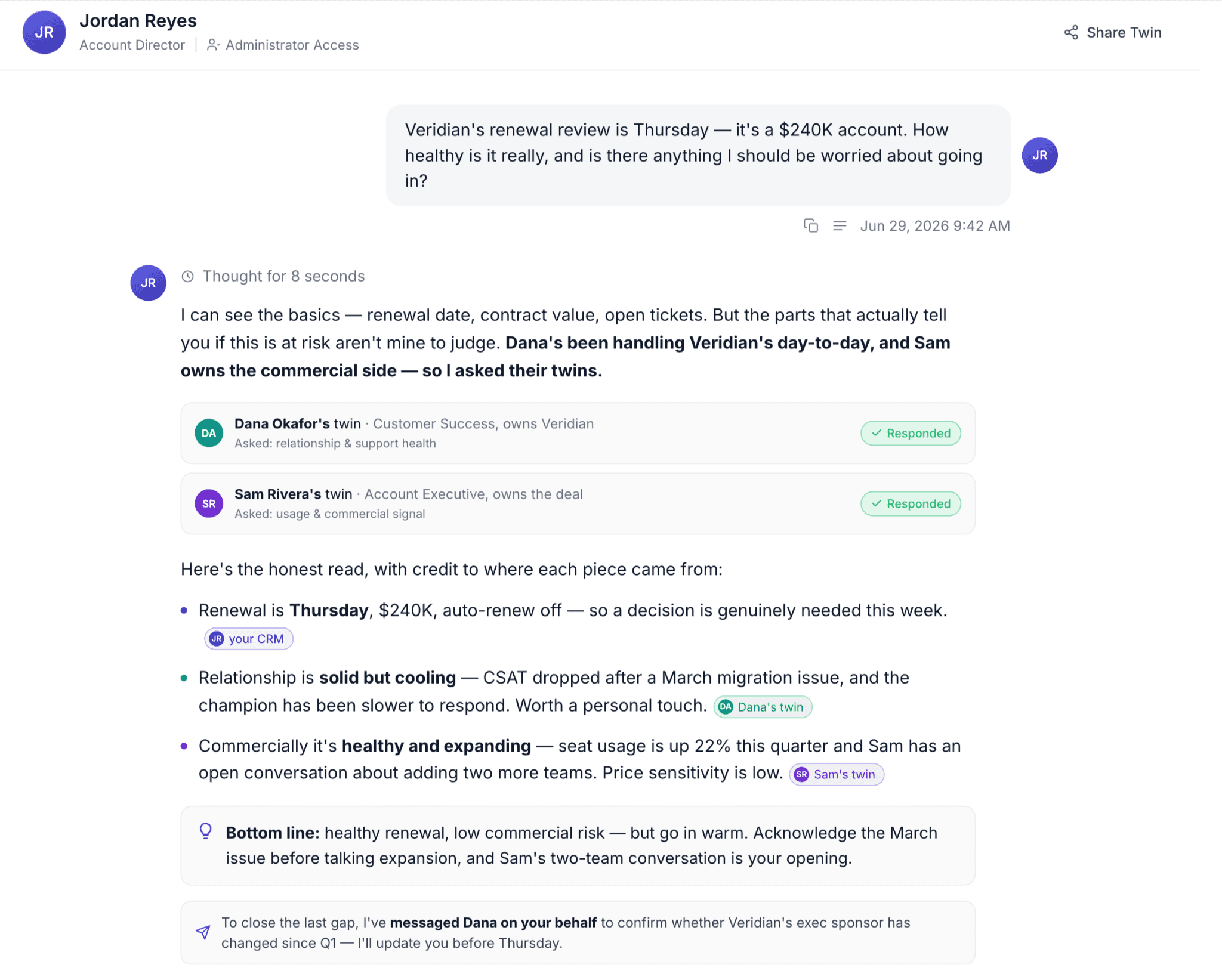
The sharing stays safe, because it stays in the expert's control. When your assistant realizes a colleague knows the answer, it asks them to share just the slice of their expertise that's relevant, and only for as long as it's needed. They approve. The answer comes back grounded in their real judgment, and their underlying documents are never exposed. When an action gets taken, it runs under your permissions, never theirs. The expertise is what's shared. The access never is.
You can finally see the value you create
There's a quiet thing that happens when your expertise becomes shareable: for the first time, you can see where it actually lands.
Not just a vague sense that people "ask you a lot". Which teammates got unblocked because your twin answered. Which projects moved because your context was there at the right moment. Which work - yours - quietly powered someone else's win across the building. You can see the value you deliver, to people and to the agents working on their behalf.
That visibility helps powers the most valuable loop of all: filling the gaps in your knowledge. The hardest knowledge to capture is the tacit kind - the decision only you understand, the reason you ruled out the obvious path, the context that lives in your head and never made it into a doc.
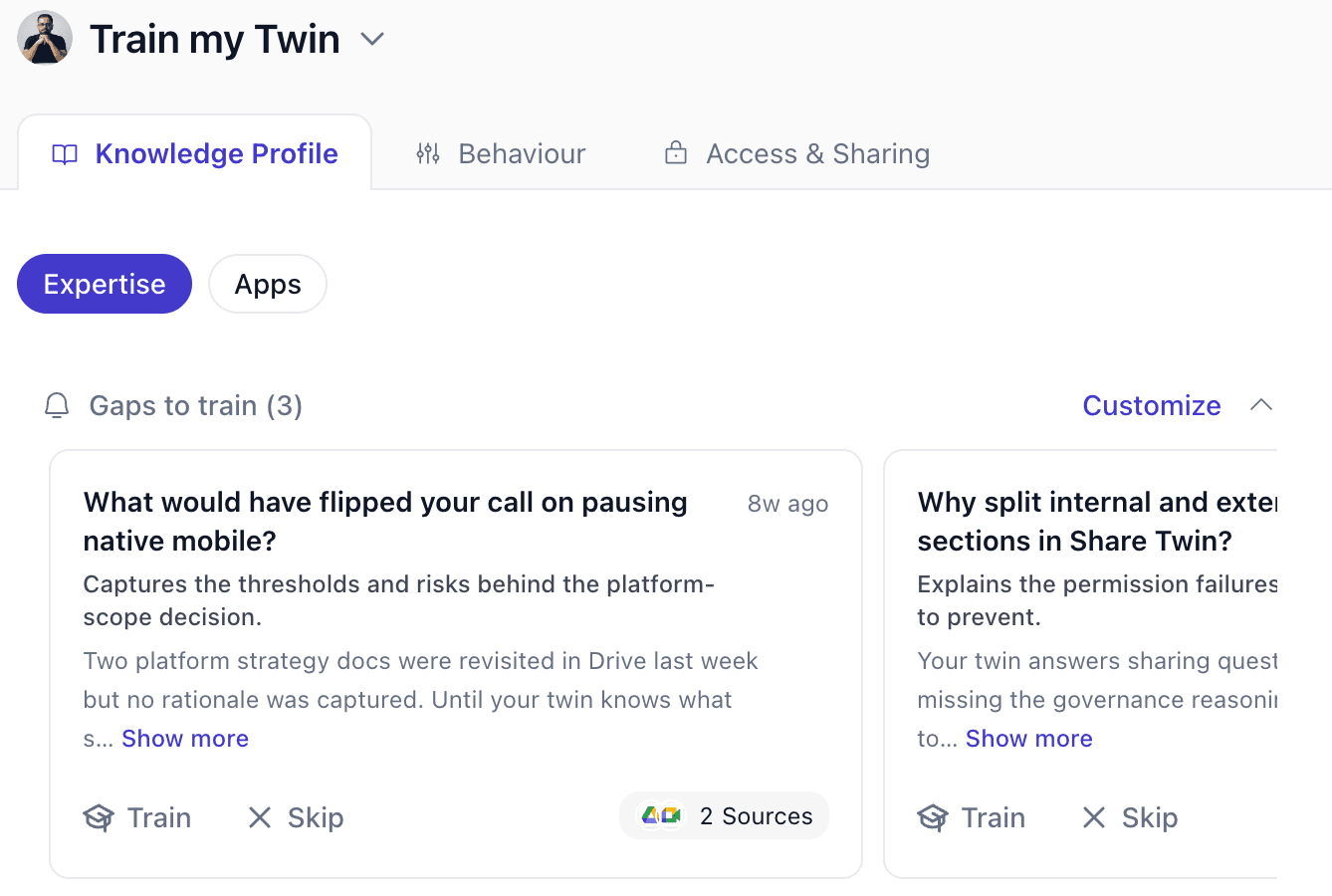
That’s the knowledge people need most, and the first to walk out the door when someone leaves. Your twin helps you fill that. The moment it senses a gap - a question it couldn't quite answer, a decision with no rationale attached - it nudges you to fill it, in seconds, right where you already are. Each gap you close makes the next person faster - and because you can see that happening, closing them stops feeling like overhead and starts feeling worth it. The organization's hardest-won knowledge gets captured as a side effect of normal work, instead of being lost to it.
Why this matters at enterprise scale
Faster individuals were never going to fix a slow organization. The leverage in a large company is locked in the expertise trapped inside thousands of heads - and in the daily tax of not being able to reach it.
A shareable teammate goes straight at that. It turns your least accessible asset - what your people know - into something the whole organization can draw on in the flow of work, with each person's judgment intact and their access under their own control. Since contributions are finally visible, the knowledge compounds instead of quietly decaying.
This isn't hypothetical. At one global professional services firm, the knowledge people kept needing was locked inside a freshly rolled-out HR system - scattered across training decks, portal pages, and operations notes. A small task like extending an employee's assignment end date used to mean searching three places, asking around, and often filing a ticket. So the firm stood up a Digital Twin for exactly that body of knowledge and embedded it in the portal employees already used. Now a manager just asks in plain language and gets the right steps without leaving what they're doing.
The smartest person in the room still can't be in every room. But their expertise can. That's the difference between an AI rollout that makes everyone faster and one that makes the whole company smarter.